
Welcome to Basic Calculator Tool! Whether you are a student tackling middle-school mathematics or a professional working on scaling measurements, understanding ratios and proportions is an essential skill.
In this comprehensive guide, we will break down everything you need to know about proportions, formulas, step-by-step solving methods, and how you can use our free online proportion calculator to save time and get instant, accurate results.
What is a Proportion in Math?
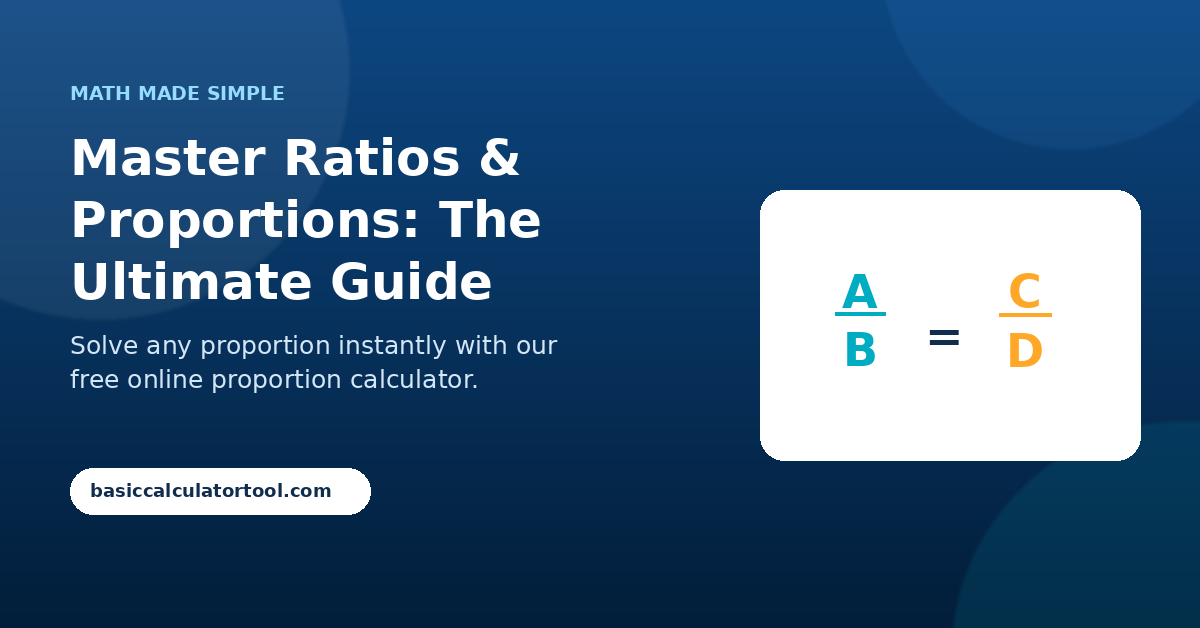
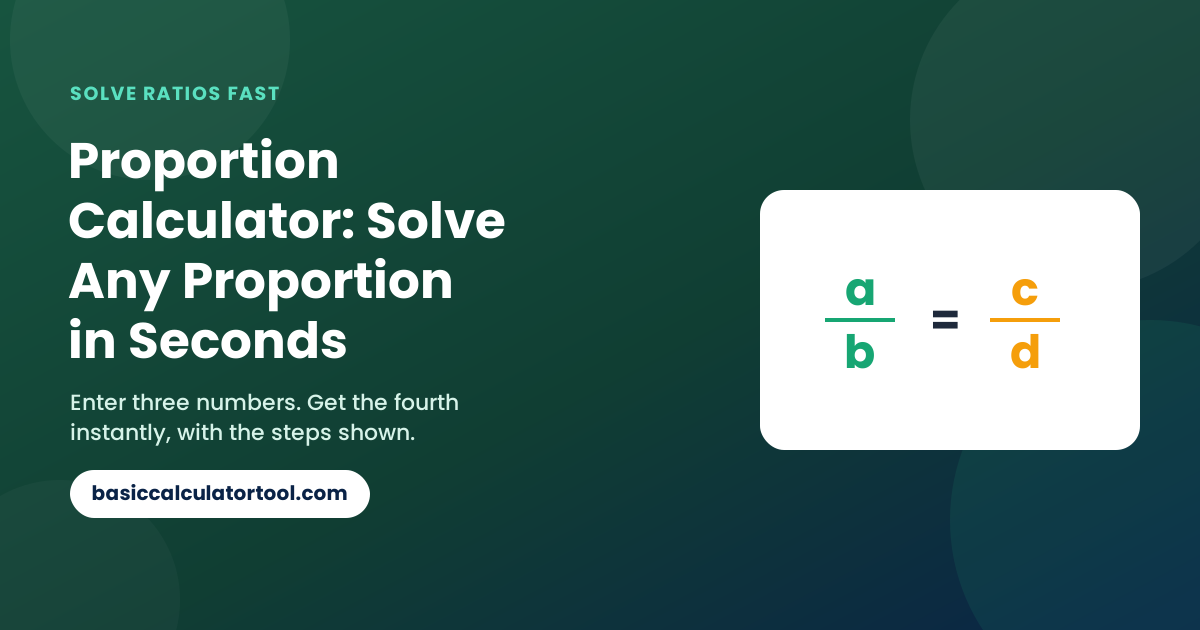
At its core, a proportion is an equation that states that two ratios are equal. In mathematical terms, if two ratios ab and cd are equal, they can be written as a proportion:
\frac{a}{b} = \frac{c}{d} \quad \text{or} \quad a:b = c:d
This is read as "a is to b as c is to d."
Difference Between Ratio and Proportion
Many beginners confuse ratios and proportions. Let's clear up the confusion:
- Ratio: A comparison of two quantities of the same unit (e.g., the ratio of boys to girls in a class is 3:2).
- Proportion: An equation showing that two ratios are equivalent (e.g., 32=64).
Ratio and Proportion Formulas & Core Concepts
Understanding the underlying formulas makes manual calculations much easier. Here are the core concepts you need to master:
- The Cross-Product Rule: If ab=cd, then ad=bc. This is the golden rule for solving missing values.
- Direct Proportion: Two quantities increase or decrease together at a constant rate. If y=kx (where k is a constant), doubling x doubles y.
- Inverse (Indirect) Proportion: When one quantity increases while the other decreases proportionally. Written as y=kx or xy=k.
How to Solve Proportions Step by Step
Solving a proportion usually means finding a missing value (let's call it x). Here is how you can do it manually using cross-multiplication:
Example Problem:
Solve for x in the proportion: 34=x12
- Step 1: Set up the cross-multiplication equation. Multiply the numerator of the first fraction by the denominator of the second, and set it equal to the denominator of the first multiplied by the numerator of the second.

Proportion Word Problems with Solutions
Let’s look at a practical word problem to see how this applies to everyday life.
Problem: A car travels 150 miles on 5 gallons of gasoline. How many gallons will it need to travel 450 miles?
- Step 1: Set up the proportion.
\frac{150 \text{ miles}}{5 \text{ gallons}} = \frac{450 \text{ miles}}{x \text{ gallons}}
- Step 2: Cross-multiply.
150x=5450
150x=2250
- Step 3: Isolate x.
x=2250150=15
- Answer: The car will need 15 gallons of gasoline to travel 450 miles.
Speed Up Your Work with Our Tools
Why do math by hand when you can get instant answers? If you are looking for a quick and reliable way to check homework, scale recipes, or handle engineering calculations, head over to our main platform. You can test out our proportion calculator for instant step-by-step solving, or use our specialized Proportional calculatoe widget to handle advanced cross-multiplication problems effortlessly.
Frequently Asked Questions (FAQs)
1. What is the easiest way to solve a proportion?
The easiest and most reliable method is cross-multiplication. Multiply the two diagonal numbers across the equals sign and divide by the remaining number to find your unknown variable.
2. Can negative numbers be used in proportions?
Yes! Proportions can involve negative numbers, though the resulting ratios must still maintain mathematical equivalence on both sides of the equation.
3. How do I find a missing number in a proportion online?
You can use a digital tool like the one provided by Basic Calculator Tool. Simply input your known values into the fields, and our solver will compute the missing variable instantly with zero manual effort.
Conclusion
Mastering ratios and proportions opens the door to solving countless everyday problems—from scaling cooking recipes to financial forecasting and physics equations. Whenever you are stuck on a tough equation, remember you don't have to do it alone. Save time, check your work, and streamline your calculations using the tools right here at Basic Calculator Tool!
.png)