.png)

A proportion is a statement that two ratios are equal. If one pack of pencils costs $3, then two packs cost $6 and five packs cost $15. Each of those prices grows at the same rate as the number of packs, so they all belong to the same proportion.
Proportions show up in cooking, shopping, travel, construction, school math, and countless other places. The mathematics is not hard, but small slips in setting up or multiplying can lead to wrong answers. That is where a proportion calculator helps. You enter the values you know, and the tool finds the missing one in seconds.
This guide explains how a proportion calculator works, how to calculate a proportion by hand, and how to handle direct and inverse proportion. It also covers common mistakes, so you can trust your results and understand the math behind them.
What Is a Proportion Calculator?
A proportion calculator is a tool that finds a missing value in a proportion. You give it three numbers, and it works out the fourth so that both sides of the equation are equal. You may also see it called a proportional calculator or a proportionality calculator, and many people search for a proportion calculator online because it is quick and needs no setup.
Typical problems it can solve include:
⦁ Scaling a recipe up or down
⦁ Converting between quantities, such as price per item
⦁ Working out distances on maps or scale drawings
⦁ Finding unknown values in school proportion questions
Simple example: Suppose 3 notebooks cost $12. How much do 5 notebooks cost?
3 / 12 = 5 / x
A proportion calculator returns x = 20, so 5 notebooks cost $20. You get the answer without doing any manual arithmetic.
How Does a Proportion Calculator Work?
Behind the interface, a proportion calculator uses cross multiplication. Take the standard form:
a / b = c / x
Here, a, b, and c are known values, and x is the unknown. Cross multiplication means multiplying diagonally across the equals sign:
a × x = b × c
Then divide both sides by a to isolate x:
x = (b × c) / a
Worked example: Solve 4 / 10 = 6 / x.
1. Cross multiply: 4 × x = 10 × 6
2. Simplify: 4x = 60
3. Divide both sides by 4: x = 15
You can check this by confirming that 4/10 and 6/15 are equal. Both simplify to 2/5, so the answer is correct.
A good calculator performs these steps instantly and displays the result, sometimes along with the working.
How to Calculate a Proportion Manually
Knowing how to calculate a proportion by hand helps you understand what the calculator is doing and lets you spot a suspicious result. The method is the same each time.
1. Write the proportion as two equal fractions.
2. Put the unknown value in place as x.
3. Cross multiply.
4. Divide to find x.
5. Check your answer by substituting it back.
Example 1: Finding a Missing Number
Solve 7 / 21 = x / 9.
1. Cross multiply: 7 × 9 = 21 × x
2. Simplify: 63 = 21x
3. Divide both sides by 21: x = 3
Check: 7/21 simplifies to 1/3, and 3/9 also simplifies to 1/3. The answer is correct.
Example 2: A Real-World Calculation
A car uses 8 liters of fuel to travel 100 kilometers. How much fuel does it need to travel 250 kilometers, assuming consistent driving conditions?
8 / 100 = x / 250
1. Cross multiply: 8 × 250 = 100 × x
2. Simplify: 2,000 = 100x
3. Divide by 100: x = 20
The car needs 20 liters of fuel.
Calculating proportion this way is reliable, but it takes a moment. Using a calculator to confirm your answer is a good habit.
Proportion Formula
The core proportion formula is:
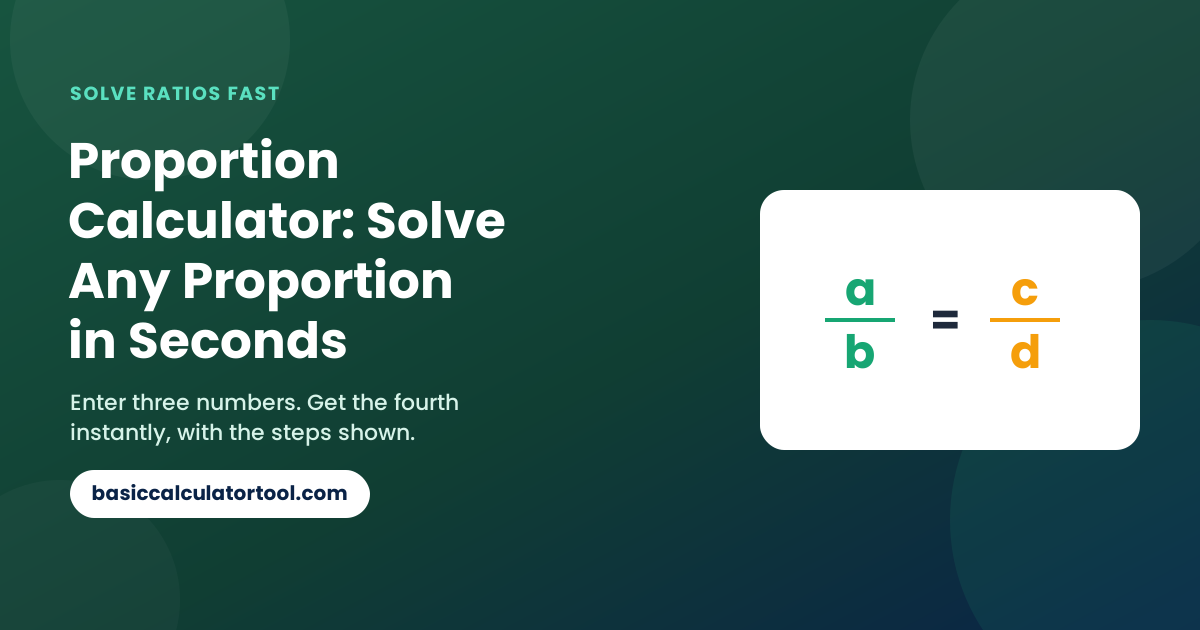
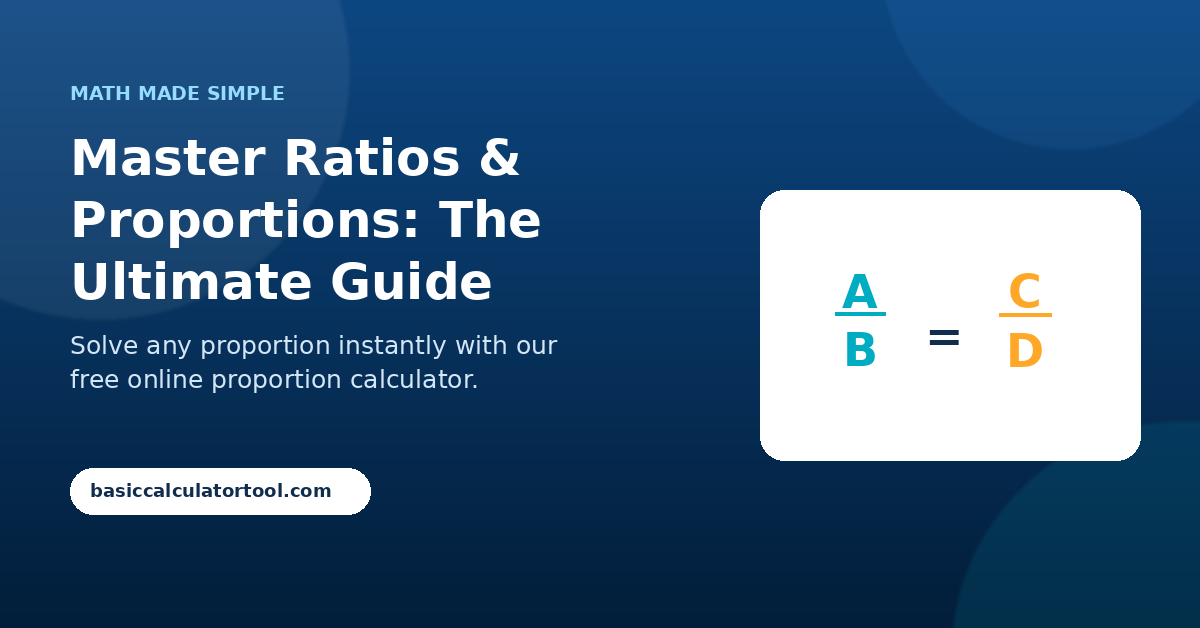
a / b = c / d
Each variable has a meaning:
⦁ a and b form the first ratio
⦁ c and d form the second ratio
⦁ The equals sign says both ratios have the same value
This proportion equation can also be written with colons: a : b = c : d.
Cross Multiplication Rule
The most useful property of this formula for proportion problems is that the cross products are equal:
a × d = b × c
This is the proportion calculation formula that calculators rely on. To solve for any single unknown, rearrange it:
⦁ If d is unknown: d = (b × c) / a
⦁ If a is unknown: a = (b × c) / d
⦁ If b is unknown: b = (a × d) / c
⦁ If c is unknown: c = (a × d) / b
Once you remember this relationship, learning how to solve proportions becomes simple. Identify the unknown, cross multiply, and divide.
How to Use a Proportion Calculator
Most online tools follow a similar layout. Here is a beginner-friendly process:
1. Enter the first known value in the first field (for example, 3).
2. Enter the second value that pairs with it (for example, 12).
3. Enter the third value that belongs in the second ratio (for example, 5).
4. Leave the unknown value blank, or mark it as x, depending on the tool.
5. Click calculate.
6. Review the result and make sure it makes sense in context.
Tip: Always match the order of your values. If the first ratio is "notebooks to dollars," the second ratio must also be "notebooks to dollars." Mixing the order is one of the most common causes of wrong answers.
When the calculator returns a value, ask whether it seems reasonable. If more items should cost more money, but your answer is lower, something was likely entered incorrectly.
Direct Proportion
Direct proportion describes a relationship where two quantities increase or decrease together at the same rate. If one doubles, the other doubles. If one is cut in half, so is the other. This is also called direct proportionality, and we say the quantities are directly proportional.
Direct Proportion Formula
The direct proportion formula is:
y = kx
or equivalently:
y / x = k
Here, y and x are the two quantities, and k is a constant (the constant of proportionality, covered below). Because y/x stays the same, you can set up a proportion between any two pairs of values:
y₁ / x₁ = y₂ / x₂
Real-Life Example
A worker earns $15 per hour. How much do they earn in 8 hours? Earnings are directly proportional to hours worked.
15 / 1 = x / 8
x = 15 × 8 = 120. The worker earns $120.
Another Example
If 6 apples weigh 900 grams, how much do 10 apples weigh?
6 / 900 = 10 / x
1. Cross multiply: 6x = 9,000
2. Divide by 6: x = 1,500
Ten apples weigh 1,500 grams.
A direct proportion calculator is useful whenever a problem involves a steady rate, such as price per unit, speed, or wages. It saves time when you have several conversions to perform.
Inverse Proportion
Inverse proportion describes a relationship where one quantity increases while the other decreases, so that their product stays constant. This is also called inverse proportionality, and the quantities are inversely proportional.
Inverse Proportion Formula
The inverse proportion formula is:
y = k / x
or equivalently:
x × y = k
For two pairs of values, this gives:
x₁ × y₁ = x₂ × y₂
Notice that you multiply across rather than set up equal fractions. This is the key difference from direct proportion.
Real-Life Example
It takes 4 workers 6 days to paint a building. How long would it take 8 workers, assuming they all work at the same pace? More workers means fewer days, so this is an inverse relationship.
4 × 6 = 8 × x
24 = 8x, so x = 3. It would take 8 workers 3 days.
Another Example
A car traveling at 60 km/h takes 5 hours to complete a trip. How long would the same trip take at 100 km/h?
60 × 5 = 100 × x
300 = 100x, so x = 3. The trip would take 3 hours.
An inverse proportion calculator is helpful because many people mistakenly use the direct method on these problems. A tool designed for inverse relationships applies the correct formula and avoids that error. If your calculator only handles direct proportions, you can still solve an inverse problem by flipping one of the ratios.
Proportion Problems and Examples
Practice is the best way to become comfortable with proportion questions. Here are several proportion examples covering everyday situations. In each case, solving proportion problems comes down to the same steps: set up two equal ratios, cross multiply, and solve.
Prices
If 4 bottles of juice cost $10, how much do 14 bottles cost?
4 / 10 = 14 / x
4x = 140, so x = 35. The 14 bottles cost $35.
Distance
A map uses a scale where 2 cm represents 15 km. Two cities are 7 cm apart on the map. What is the real distance?
2 / 15 = 7 / x
2x = 105, so x = 52.5. The real distance is 52.5 km.
Quantities
A school has 3 teachers for every 60 students. How many teachers are needed for 200 students at the same ratio?
3 / 60 = x / 200
60x = 600, so x = 10. The school needs 10 teachers.
Recipes
A recipe for 4 servings uses 300 grams of flour. How much flour is needed for 10 servings?
300 / 4 = x / 10
4x = 3,000, so x = 750. You need 750 grams of flour.
Time
A printer produces 45 pages in 3 minutes. How many pages does it print in 8 minutes at the same rate?
45 / 3 = x / 8
3x = 360, so x = 120. The printer produces 120 pages.
Everyday Calculations
You drive 180 km using 12 liters of fuel. How much fuel would you need for 420 km?
180 / 12 = 420 / x
180x = 5,040, so x = 28. You would need 28 liters.
These proportion word problems follow a clear pattern. Once you see it, you can apply it to almost any situation involving a constant rate.
Ratio and Proportion
Ratio and proportion are closely related, but they are not the same thing.
A ratio compares two quantities. For example, if a class has 12 girls and 18 boys, the ratio of girls to boys is 12:18, which simplifies to 2:3.
A proportion states that two ratios are equal. For example, 2:3 = 10:15 is a proportion.
Difference Between Ratio and Proportion
⦁ A ratio is a comparison. A proportion is an equation.
⦁ A ratio has two terms (a : b). A proportion has four (a : b = c : d).
⦁ You can simplify a ratio. You can solve a proportion for an unknown value.
In short, ratio proportion work starts with ratios and uses proportions to find missing values.
When You Might Need a Ratio and Proportion Calculator
A ratio and proportion calculator is useful when you need to:
⦁ Scale a mixture, such as paint, concrete, or a cleaning solution
⦁ Resize an image while keeping its shape
⦁ Divide a quantity into parts according to a given ratio
⦁ Solve textbook problems that combine both ideas
For example, if paint is mixed in a ratio of 2 parts blue to 3 parts white, and you use 9 parts white, how much blue do you need?
2 / 3 = x / 9
3x = 18, so x = 6. You need 6 parts blue.
Constant of Proportionality
The constant of proportionality is the fixed number that connects two quantities in a proportional relationship. It is also called the proportionality constant or the unit rate.
Formula
k = y / x
Here, k is the constant, y is the dependent quantity, and x is the independent quantity.
Simple Example
A store sells pens at a steady price. Three pens cost $6.
k = 6 / 3 = 2
The constant of proportionality is 2, meaning each pen costs $2. You can now find the cost of any number of pens with y = 2x. For 9 pens, y = 2 × 9 = $18.
How It Connects to Proportional Relationships
A proportional relationship exists when the ratio y/x is the same for every pair of values. The proportional relationship formula is:
y = kx
You can test a table of values to see if it is proportional by dividing each y by its x:
Every ratio is 5, so the relationship is proportional and k = 5. Graphically, proportional relationships form a straight line through the origin (0, 0). If the line does not pass through the origin, or the ratios differ, the relationship is not proportional.
Common Mistakes When Solving Proportions
Even simple proportion problems can go wrong. Here are the most frequent errors and how to avoid them.
Entering Values in the Wrong Order
If the first ratio is "miles : hours," the second must also be "miles : hours." Swapping positions gives an incorrect answer. Write labels next to each number before you enter them into a calculator.
Confusing Direct and Inverse Proportion
Ask yourself: when one quantity goes up, does the other go up too (direct) or go down (inverse)? More workers finishing a job faster is inverse. More items costing more money is direct.
Incorrect Cross Multiplication
Multiply diagonally: top left by bottom right, and top right by bottom left. A common slip is multiplying across the top or bottom instead.
Misunderstanding Ratios
A ratio of 2:3 does not mean 2 out of 3 in total. It means 2 parts to 3 parts, which makes 5 parts altogether. Reading this wrongly can distort part-whole problems.
Ignoring Units
Convert before calculating. If one ratio uses minutes and the other uses hours, the result will be wrong. For example, 30 minutes should be written as 0.5 hours if the other ratio uses hours.
Rounding Too Early
Rounding intermediate steps can create noticeable errors in the final answer. Keep full precision until the end, then round once.
A proportion calculator reduces arithmetic and rounding errors and helps you check your work. However, it cannot detect a wrongly set up problem. Understanding the formula is what lets you catch an input mistake.
Benefits of Using a Proportion Calculator
Used sensibly, a proportion calculator offers several practical advantages:
⦁ Faster calculations: Answers appear in seconds, which is helpful when you have many problems to solve.
⦁ Fewer arithmetic mistakes: The tool handles multiplication and division accurately.
⦁ Easy verification: You can check hand-calculated answers quickly.
⦁ Useful for students: It supports homework practice and builds confidence when learning how to calculate proportion.
⦁ Useful for teachers: It helps create and check examples and answer keys.
⦁ Everyday convenience: It helps with recipes, shopping comparisons, budgeting, and scale conversions.
⦁ Support for complex problems: When numbers are large or decimals are involved, it removes much of the tedious work.
It is best treated as a support tool rather than a replacement for understanding. Students especially benefit when they try a problem by hand first and then use the calculator to confirm the result.
Frequently Asked Questions About Proportion Calculators
What is a proportion calculator?
A proportion calculator is an online or digital tool that finds a missing value in a proportion when the other three values are known. It uses cross multiplication to solve equations of the form a/b = c/d.
How do you calculate a proportion?
Write two equal fractions, place the unknown as x, cross multiply, and divide to solve. For example, for 2/5 = 6/x, cross multiplying gives 2x = 30, so x = 15.
What is the formula for a proportion?
The formula is a/b = c/d, which can be rewritten as a × d = b × c. Rearranging this equation lets you solve for any unknown value.
Can a proportion calculator solve direct proportions?
Yes. Direct proportion is the standard use case. If two quantities increase or decrease together at the same rate, a proportion calculator can find the missing value directly.
Can a proportion calculator solve inverse proportions?
Some can, but not all. Inverse proportion uses the rule x₁ × y₁ = x₂ × y₂ rather than equal fractions. If a calculator only supports direct proportion, you can still solve an inverse problem by inverting one of the ratios before entering the values.
What is the difference between ratio and proportion?
A ratio compares two quantities, such as 3:4. A proportion says two ratios are equal, such as 3:4 = 6:8.
What is the constant of proportionality?
It is the fixed value k in the equation y = kx. You find it by dividing y by x. For example, if 4 meters of ribbon cost $10, k = 10 / 4 = 2.5 dollars per meter.
How accurate is an online proportion calculator?
The arithmetic is generally very accurate. The main risk is user input. If you enter values in the wrong order or use mismatched units, the result will be wrong even though the calculation itself is correct. Always check that your answer makes sense in context.
Conclusion
Proportions are among the most practical tools in mathematics. They connect ratios, rates, and scaling, and they apply to everything from recipes to maps to wages. Once you understand the proportion formula, you can solve problems by cross multiplying, whether the relationship is direct or inverse.
A proportion calculator makes this process faster and reduces arithmetic errors, but it works best when you understand what it is doing. Knowing how to set up the equation, identify direct or inverse relationships, and interpret the constant of proportionality helps you catch mistakes before they matter.
Use the calculator to save time and confirm your answers, and use the formulas to understand why those answers are correct. Together, they make proportional calculations simpler, more reliable, and easier to apply to everyday problems.