
Introduction
Ever tried to scale a recipe, resize an image, or read a map and felt stuck on the math? You are not alone. The good news is that a proportion calculator can handle all of it in seconds. You enter three numbers, and it gives you the fourth.
But a calculator works best when you understand what it is doing. In this guide, you will learn what a proportion is, how the math works, and how to avoid the most common errors. You will also see three worked examples and real-life uses.
Whether you are a student doing homework, a teacher preparing a lesson, a designer resizing artwork, or a professional running quick numbers, this guide will save you time.
What Is a Proportion?
A proportion is a statement that two ratios are equal. A ratio compares two quantities, such as 3 apples to 4 oranges. When two ratios have the same value, they form a proportion.
Here is a simple example:
1/2 = 4/8
Both sides equal 0.5, so the two ratios are proportional.
You will see proportions written in a few ways:
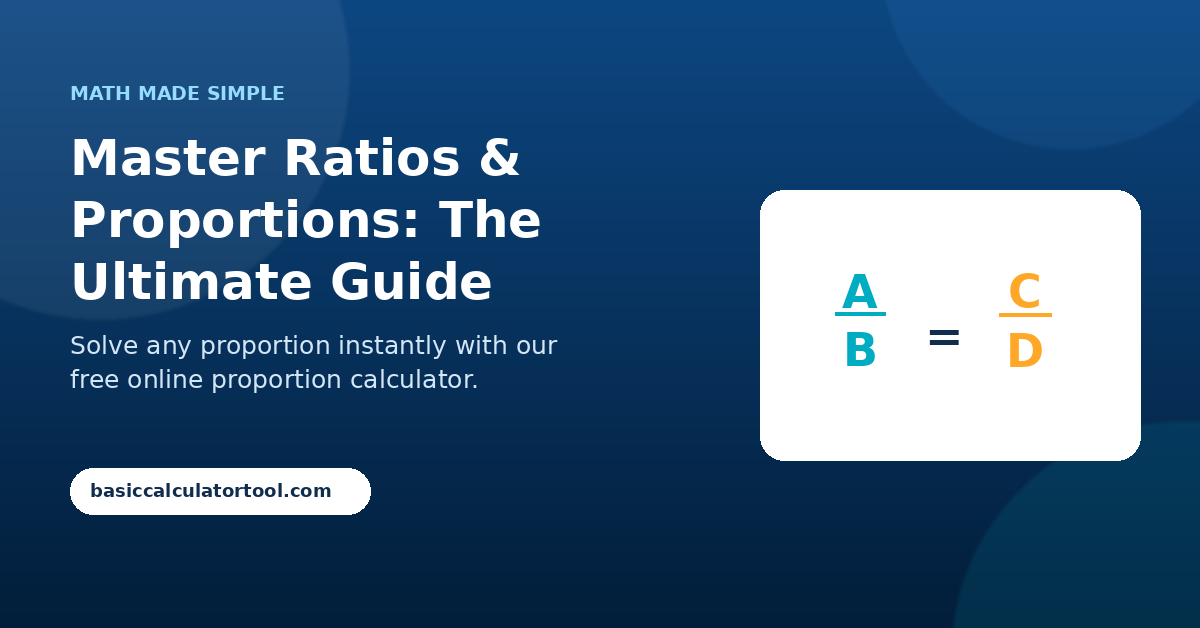
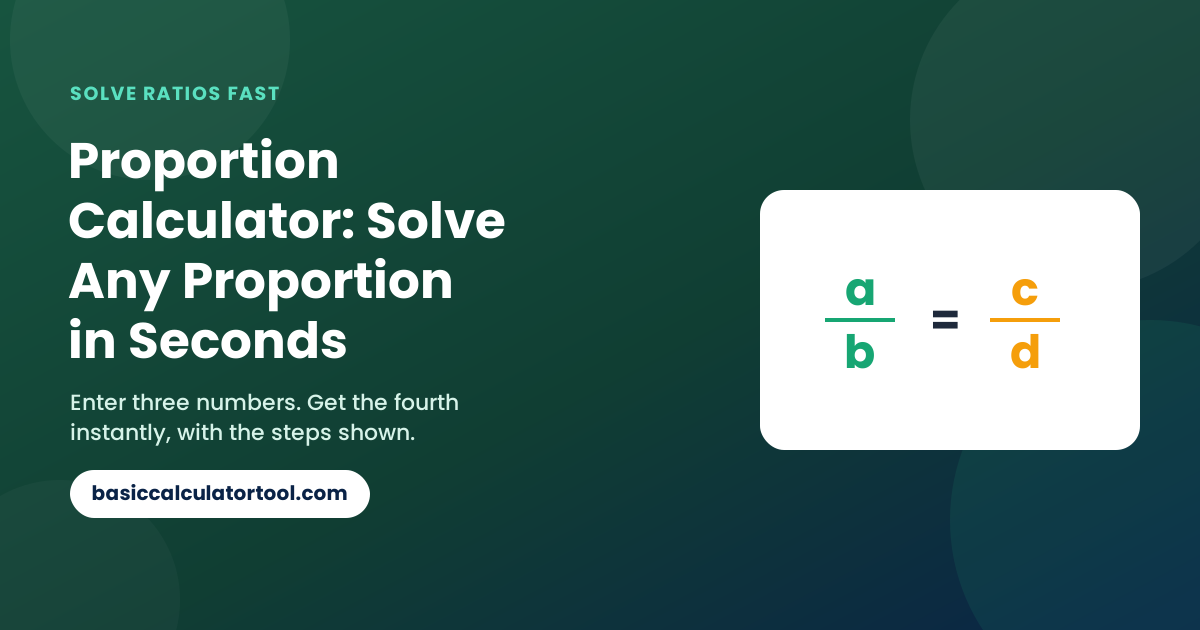
- Fraction form: a/b = c/d
- Colon form: a : b = c : d
- Words: "a is to b as c is to d"
All three mean the same thing. The key idea is that one quantity changes at the same rate as another. If you double one, you double the other.
Ratio vs. Proportion: What Is the Difference?
People mix these up all the time. Here is the quick version:
- A ratio compares two numbers (like 2:3).
- A proportion says two ratios are equal (like 2:3 = 4:6).
Think of a ratio as a single comparison and a proportion as an equation built from two comparisons.
Direct vs. Inverse Proportion
Most everyday problems use direct proportion. When one value goes up, the other goes up too. If one notebook costs $3, then four notebooks cost $12.
Inverse proportion works the opposite way. When one value goes up, the other goes down. If 2 workers finish a job in 6 days, then 4 workers finish it in 3 days.
This article focuses on direct proportions, which is what most online tools solve.
How a Proportion Calculator Works (Step by Step)
A proportion calculator follows the same steps you would use on paper. It just does them instantly. Here is what happens behind the screen:
- You enter three known values. The tool has four boxes, laid out as a/b = c/d. You fill in any three and leave one blank.
- The tool spots the unknown. It marks the empty box as the value to solve for, usually called x.
- It applies cross multiplication. The calculator multiplies diagonally across the equals sign.
- It rearranges the equation. Using basic algebra, it isolates the unknown value.
- It divides to get the answer. The final division gives you x.
- It shows the result. Many tools also display the steps so you can learn from them.
Let us see this with a quick example. Suppose you enter 2, 5, and 8 into the boxes for 2/5 = x/8.
- Cross multiply: 2 × 8 = 5 × x
- Simplify: 16 = 5x
- Divide: x = 16 ÷ 5 = 3.2
That is the whole process. A good proportion calculator does this without errors, even with decimals or large numbers.
Manual vs. Calculator: A Quick Comparison
| Feature | Solving by Hand | Using a Calculator |
| Speed | 1 to 3 minutes | 2 seconds |
| Risk of arithmetic errors | Medium to high | Very low |
| Works with decimals and fractions | Yes, but slower | Yes, instantly |
| Shows learning steps | You write them | Often built in |
| Best for | Exams and practice | Homework checks, work, daily tasks |
| Needs internet | No | Usually yes |
The best approach is to use both. Practice by hand to build understanding, then use the calculator to check your work and save time.
Formula for Proportions (a/b = c/d)
The core formula is simple:
a/b = c/d
To solve it, you use cross multiplication:
a × d = b × c
From there, you can find any missing value:
- Find a: a = (b × c) ÷ d
- Find b: b = (a × d) ÷ c
- Find c: c = (a × d) ÷ b
- Find d: d = (b × c) ÷ a
The formula is the engine inside every proportion calculator you will find online. Let us walk through three examples.
Example 1: A Basic Missing Value
Problem: Solve 3/4 = x/20.
- Cross multiply: 3 × 20 = 4 × x
- Simplify: 60 = 4x
- Divide both sides by 4: x = 15
Answer: x = 15
Check: 15/20 simplifies to 3/4. Correct.
Example 2: Scaling a Recipe
Problem: A cookie recipe uses 2 cups of flour for 12 cookies. How much flour do you need for 30 cookies?
Set up the proportion with matching units:
cups of flour / cookies = cups of flour / cookies
2/12 = x/30
Solve it:
- Cross multiply: 2 × 30 = 12 × x
- Simplify: 60 = 12x
- Divide: x = 5
Answer: 5 cups of flour
Example 3: Reading a Map with an Unknown in the Denominator
Problem: On a map, 1 inch equals 8 miles. Two towns are 52 miles apart. How many inches apart are they on the map?
Set it up:
inches / miles = inches / miles
1/8 = x/52
Solve it:
- Cross multiply: 1 × 52 = 8 × x
- Simplify: 52 = 8x
- Divide: x = 6.5
Answer: 6.5 inches
Notice that the unknown can sit in any position. The method stays the same every time.
How to Use a Proportions Calculator
Using a proportions calculator takes less than a minute once you know the layout. Follow these steps:
- Write your problem as a ratio. Decide what compares to what. For example, "2 cups for 12 cookies" becomes 2/12.
- Place the known values in the boxes. Keep the same units in the same position on both sides. If cups are on top on the left, cups must be on top on the right.
- Leave the unknown box empty. Most tools only need you to fill in three of the four fields.
- Click "Calculate." The answer appears right away.
- Review the steps. If the tool shows its work, read it. This helps you learn the method.
- Check your answer. Plug the result back into the proportion and make sure both sides match.
Tips for Getting Accurate Results
- Use decimals instead of mixed numbers (write 1.5 instead of 1 1/2).
- Convert units first. Do not mix inches with centimeters or hours with minutes.
- Round only at the end, not in the middle of your work.
- Double-check which value is the unknown before you type anything.
If you want to practice, try the three examples above in the tool. A proportion calculator is also a great way to test your own answers after solving by hand.
Who Benefits Most?
- Students can check homework and understand each step.
- Teachers can build quick answer keys and demonstrate examples live.
- Designers can resize layouts without distorting them.
- Professionals can estimate costs, quantities, and conversions on the spot.
Real-Life Uses of Proportions
Proportions are everywhere. Once you notice them, you will use them without thinking. Here are five common areas.
Cooking and Baking
Recipes rarely match the number of people you are feeding. If a soup recipe serves 4 and you need to serve 10, a proportion tells you exactly how much of each ingredient to use.
Recipe uses 3 tomatoes for 4 servings.
You need 10 servings: 3/4 = x/10
x = 7.5, so use about 8 tomatoes.
Maps and Scale Drawings
Maps, floor plans, and blueprints all rely on scale. If 1 cm on a map equals 25 km, then 7.5 cm equals 187.5 km. You solve it with 1/25 = 7.5/x, or more simply by multiplying.
Architects and model builders use the same idea to shrink large objects into small, accurate models.
.png)