
Every eBay sale looks great until the fees come out. A $50 item does not put $50 in your pocket. Fees, shipping, packaging, and the cost of the product all reduce what you actually keep. If you want to price items with confidence, you need to know how to calculate eBay fees before you hit "List item."
This guide walks US sellers through the basics: what the fees are, how to estimate them step by step, and how to turn those numbers into a realistic profit figure. It is written for beginners, resellers, and small business owners.
What Are eBay Selling Fees?
eBay selling fees are the charges a seller may pay to list and sell items on the platform. Not every seller pays every fee, and the amounts depend on your account type, your category, and the services you choose.Here are the main types of charges you may run into:
• Final value fee: The main fee, charged when an item sells. It is usually a percentage of the total sale amount, often with a small fixed amount per order added on.
• Promoted listing costs (optional): If you pay to advertise your listings, you may be charged an ad fee when a sale comes from that promotion.
• Store subscription (where applicable): Sellers who choose an eBay Store pay a recurring subscription, which can change the fees they pay on sales.
• Other charges: Depending on your situation, these may include fees for optional listing upgrades or additional services.
The key point is that your fees depend on your circumstances. A casual seller clearing out a closet and a business with a Store subscription may pay differently for the same item. That is why eBay seller fees explained in general terms are only a starting point, and why you should always confirm your own rates.
How to Calculate eBay Fees Step by Step
The process is the same for most sellers, even though the numbers change. Here is a simple way to estimate your eBay selling costs.Step 1: Determine your product category. Fee rates often vary by category, so a pair of sneakers and a camera lens may not be charged the same percentage.
Step 2: Check the current fee rate and conditions. Open eBay's official fee tables and look up the rate for your category and account type. Rates and thresholds can change, so avoid relying on old blog posts or memory.
Step 3: Identify the amount the fee is based on. Under eBay's rules, the final value fee is generally calculated on the total amount of the sale, not only the item price. That can include shipping charged to the buyer, and in some cases taxes. Check the current rules to see exactly what applies to you.
Step 4: Add any fixed fee. Many orders carry a small per-order fixed fee on top of the percentage. Step 5: Add other selling charges. If you usedpromoted listings or other paid services, include those costs too. Here is the simplified formula: Estimated eBay fees = (Fee rate x Fee-eligible sale amount) + Fixed per-order fee + Other selling charges
Estimated eBay fees = (Fee rate x Fee-eligible sale amount) + Fixed per-order fee + Other selling charges
This is a general formula. The exact calculation depends on your circumstances and eBay's current policies.
eBay Fee Calculation Example
Let's walk through a hypothetical sale. All numbers below are illustrative assumptions, not official current eBay rates.
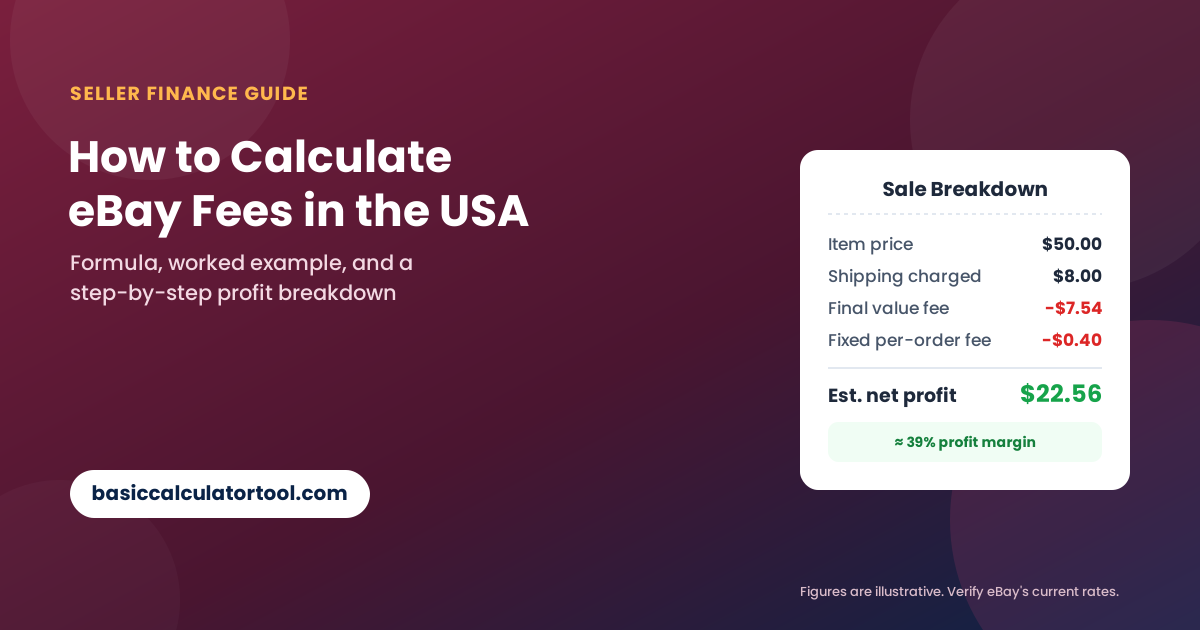
Imagine you sell a used handheld game console in the United States. You charge $50 for the item and $8 for shipping. The buyer pays both. For this example, we assume a 13% fee rate and a $0.40 fixed fee.
1. The buyer pays $58 in total: $50 for the item and $8 for shipping.
2. We apply the assumed 13% rate to $58, which gives $7.54.
3. We add the $0.40 fixed fee, so total fees are $7.94.
4. Now subtract your real costs. You paid $7.50 to ship the package and $20 to buy the console.
5. $58.00 - $7.94 - $7.50 - $20.00 = $22.56.
Notice the difference between the two shipping figures. The $8 is money the buyer paid you. The $7.50 is money you paid the carrier. They are separate numbers, and mixing them up is one of the most common beginner mistakes. In this example, the $0.50 difference stays with you, but it is also part of the amount your fee is based on. Also remember this profit is "before other business expenses." Packaging, supplies, advertising, and taxes would reduce it further.
How Much Does eBay Charge Per Sale?
There is no single answer. How much eBay charges per sale depends on several factors:• The product category
• Your seller account circumstances
• Whether you have a Store subscription
• Optional services such as promoted listings
• The total amount of the sale
Because of this, no single percentage applies to every seller or every product. Anyone who gives you one universal number is oversimplifying.
To find your actual rate, check eBay's official fee tables and the Seller Center fee information. These pages are the best place to verify current rates before you rely on any estimate.
How to Calculate Your eBay Net Profit
Revenue and profit are not the same thing. Revenue is the total money you receive from a sale. Profit is what remains after you subtract everything it cost you to make that sale happen.Here is the general formula:
Net profit = Sales revenue - applicable selling fees - product cost - shipping expenses packaging expenses - other relevant business costs
This is a simplified formula. How taxes and other costs are treated depends on your situation, and you may want to speak with a tax professional about your own obligations. A useful habit is to calculate profit per item and as a margin percentage. In our example, $22.56 profit on $58.00 of revenue is about 39%. A margin like that helps you decide whether an item is worth listing, or whether you should raise the price or skip it.
How an eBay Fee Calculator Can Help
Doing this math by hand for every listing gets old fast. An eBay profit calculator lets you plug in your numbers and see the result in seconds. A good calculator can help you:• Estimate fees before you list
• Compare different selling prices
• See your margin at each price point
• Decide whether a sourcing deal is worth it
• Spot items where costs eat most of the profit
If you want a quick way to run your own numbers, try the US eBay fee calculator on BasicCalculatorTool.com. It is a convenient way to estimate fees and profit for your own scenarios. Just remember that any calculator gives an estimate, so confirm the rates you enter against eBay's official sources.
Tips to Manage eBay Selling Costs
Small improvements in cost control add up over many sales. Here are some practical habits:• Review the official fee tables. Rates and rules change, so check them regularly.
• Calculate profit before listing. Know your margin first, not after the item sells.
• Track shipping and packaging. Boxes, tape, and labels are real costs, even when each one seems small.
• Weigh advertising and subscriptions. Promoted listings and Store plans can pay off, but only if the added sales justify the added cost.
• Check category-specific rules. Some categories have different rates or conditions.
• Recalculate when things change. If your supplier prices, shipping rates, or eBay fees move, your margins move too.
Frequently Asked Questions
How do I calculate eBay fees in the USA?
Find your category's current fee rate on eBay's official fee tables, multiply it by the fee-eligible sale amount, add any fixed per-order fee, and include other charges such as promoted listing costs.How much does eBay charge per sale?
It varies by category, account type, Store subscription, and optional services. There is no universal percentage, so check the official fee tables for your situation.Do eBay fees apply to shipping?
Often, yes. The final value fee is generally based on the total amount of the sale, which can include shipping charged to the buyer. Check eBay's current rules to confirm how it applies to your listing.How can I calculate my eBay net profit?
Start with total revenue, then subtract selling fees, the cost of the product, your actual shipping cost, packaging, and any other business costs. What remains is your estimated net profit.Conclusion
Understanding your costs is what separates a busy eBay seller from a profitable one. Once you know how eBay selling fees work, you can price items with confidence, avoid thin margins, and spot bad deals before you buy.Always verify the current rates on eBay's official pages, because fees and rules can change. Then use a tool like the US eBay fee calculator to estimate your costs and potential profit before you list.
.png)